What Is Wetlaid Nonwoven Fabric? Manufacturing Process, Properties and Applications
A nonwoven fabric is mostly settled before it ever leaves the production line. Which fibres go in, how the web gets formed, how it's bonded: those choices decide how the fabric behaves later. Among the main manufacturing routes, wetlaid is the odd one out, because it works a lot like making paper.
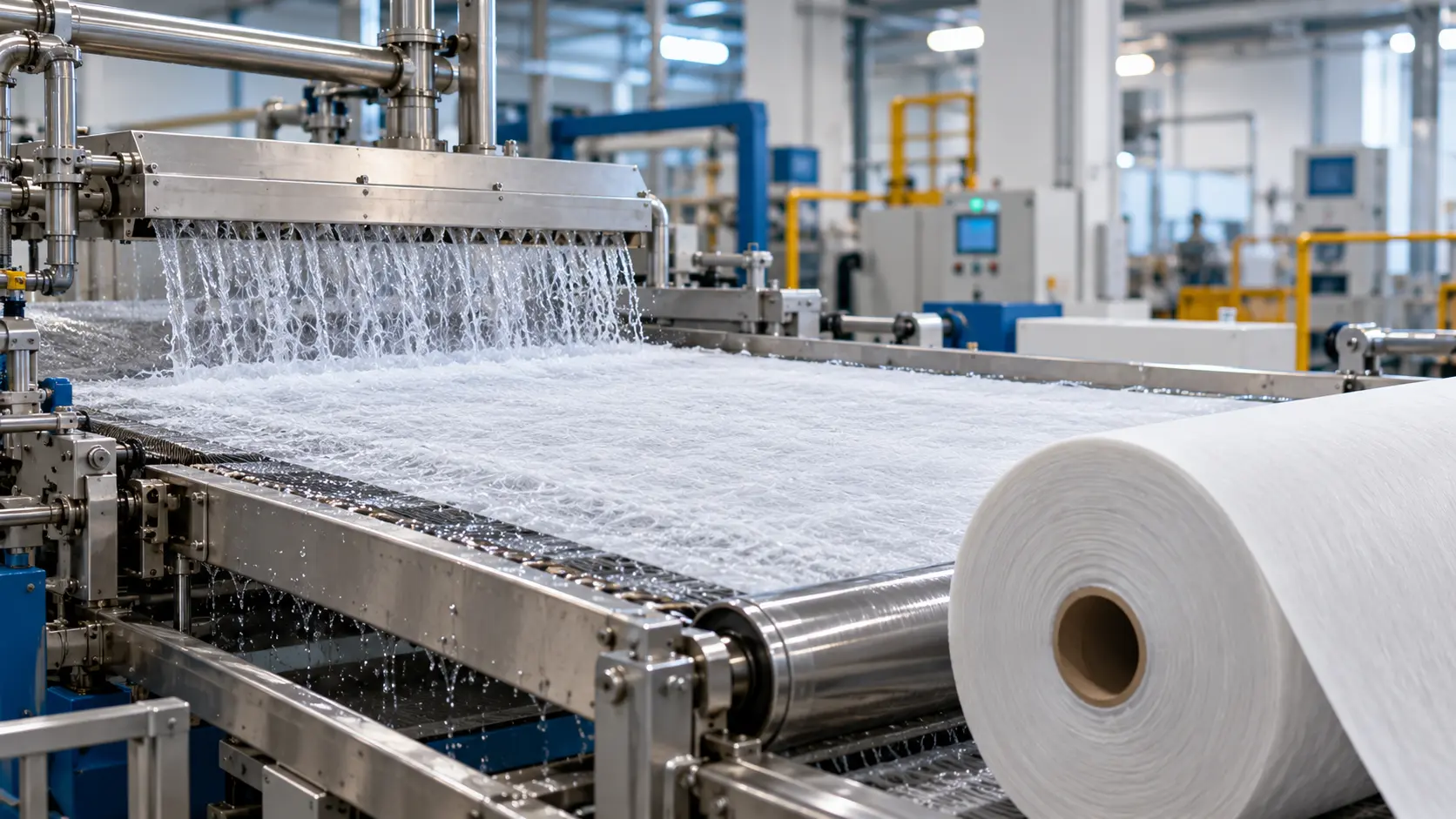
Here's the basic idea. Fibres are dispersed in water, and that thin mix is poured onto a moving screen. The water drains off. The fibres that remain form a web, and the web is then pressed, dried and finished.
It's papermaking logic applied to textile problems. That's why wetlaid can take so many different fibres, and why it shows up in specialised industrial products.
If you source or specify nonwovens, it's worth knowing how this works. You'll read a datasheet better, and you'll know what to ask about production and about fit for your application.
What Is Wetlaid Nonwoven Fabric?
Wetlaid nonwoven fabric is an engineered textile made by wet forming. Carded and spunbond fabrics are built by laying fibres or filaments down mechanically, or by spinning them straight from polymer. Wetlaid skips that. Water does the work of spreading the fibres out and forming the web.
The fibres are stirred into water to make a slurry, and the slurry is spread evenly over a moving forming screen. Water runs through the screen. Fibres don't. They pile up into a thin sheet.
What goes into the mix depends on the job. Cellulosic, synthetic, natural and mineral fibres are all options, alone or blended. Change the mix, and you change the fabric: how uniform it is, how much liquid it absorbs, how well it filters, how strong it is.
How Is Wetlaid Nonwoven Fabric Manufactured?
There are several stages in wetlaid manufacturing, and they all feed into each other. A mistake early on usually shows up in the finished fabric.
- Fibre Selection and Preparation
- It starts with choosing the raw material. Cellulose fibres, wood pulp and some synthetic fibres are the common picks. Length, fineness and flexibility matter, and so does how a fibre behaves in water. Those factors control how well the fibres spread out and whether the web ends up even.
- Fibre Dispersion
- Next, the fibres are mixed into water, in carefully controlled amounts, to form a dilute slurry. Get this wrong and the problems are easy to spot later: thick patches, thin patches, weak spots, and a fabric that doesn't perform the same from one area to another.
- Web Formation
- The slurry goes onto a screen that keeps moving. Water drains through, and the fibres settle on the surface, forming a continuous web. The way the fibres are spread and oriented at this stage has a direct effect on how uniform the material is and how it behaves physically.
- Dewatering and Consolidation
- A newly formed web is soaking wet. Pressing and vacuum-assisted drainage pull out the excess water and compact the web so it holds together before it goes to the dryer.
- Bonding and Drying
- Some webs need extra bonding, some don't. It depends on the fibres. Where it's needed, manufacturers turn to binders, thermal bonding or other methods to give the fabric the strength it requires. After that, the web is dried under controlled conditions.
- Finishing and Quality Control
- Finishing treatments vary with the application. Quality checks cover basis weight, thickness, tensile strength, absorbency and dimensional consistency, and the results are compared with the specification.
Key Properties of Wetlaid Nonwoven Fabric
No two wetlaid fabrics are quite the same, because the properties depend on the fibres, the blend, the bonding method and how the line was run. These are the characteristics that come up most:
- Fibre Distribution and Uniformity: Fibres are laid from a water suspension, so they spread across the whole web. That makes consistent construction easier to achieve.
- Flexible Fibre Composition: Cellulosic, synthetic and mineral fibres can all be used, which lets manufacturers build around a particular requirement.
- Absorbency: Cellulose-based compositions can soak up liquid well. That's why they're considered for certain absorbent products.
- Filtration Performance: Fibre mix, pore structure and web density can be adjusted, so the same basic process can serve different filtration needs.
- Structural Strength: Proper bonding and consolidation give the fabric the strength and durability its end use needs.
- Customisation: Basis weight, fibre blend, thickness and finishing treatments can all be changed to match a specification.
Not every wetlaid fabric has all of these. Always check performance against the application and the material specification.
Where Is Wetlaid Nonwoven Fabric Used?
Wetlaid technology is used in several industrial and technical areas. Here are the main ones:
- Filtration: Specialised wetlaid materials go into air, liquid and industrial filtration systems. Pore structure and fibre composition decide which one suits.
- Industrial Applications: Engineered fibre webs can serve as industrial substrates, protective materials and other technical products.
- Hygiene and Wipes: Certain wetlaid constructions are developed for disposable cleaning and absorbent products.
- Medical Applications: Some nonwoven constructions can be used in selected medical and healthcare products, as long as they meet the performance and regulatory standards that apply.
- Construction and Building Materials: In a few construction uses, wetlaid webs act as substrates or reinforcement.
- Automotive Applications: Specialised fibre structures turn up in filtration, insulation and other automotive components.
What a wetlaid material is finally used for comes down to its composition, bonding system, physical properties and the performance standards it must meet.
Wetlaid vs Other Nonwoven Manufacturing Technologies
The four main technologies form and bond fibres differently. Seeing those differences helps when you're matching a material to an application.
Wetlaid Technology: Water disperses the fibres and forms an even web. It accepts many fibre combinations, and it suits applications where controlled construction matters.
Drylaid Technology: Fibres are opened, separated and arranged mechanically, by carding or airlaying. You get more freedom over fibre orientation and web construction.
Spunbond Technology: Thermoplastic polymer is converted directly into continuous filaments, which are laid into a web and bonded. It's the usual choice when strength, consistency and a continuous filament structure are needed.
Spunlace Technology: High-pressure water jets entangle the fibres mechanically and hold the fabric together. It's common in wipes and hygiene products, and in other uses where softness and fabric integrity matter.
None of them wins every time. The choice depends on the fibres, the properties you need, how the material will be produced and where it will end up.
How Elixrr Approaches Advanced Nonwoven Manufacturing
Consistent manufacturing and technologies that work well together both matter when materials are developed for changing industrial needs.
Elixrr Nonwovens uses wetlaid technology within its proprietary PentaTech manufacturing platform, next to other nonwoven processes.
With these technologies and material capabilities in one platform, fibre selection, web formation, bonding and finishing can be matched to different technical and industrial requirements.
Explore Elixrr's PentaTech manufacturing technology and range of nonwoven fabric solutions to understand its manufacturing capabilities.
Conclusion
Wetlaid nonwoven fabric is a versatile way to make engineered fibrous materials. Forming the web in water allows for varied fibre combinations, controlled construction and performance built around the application.
Industrial requirements keep shifting, so it helps to understand the manufacturing technology and material properties before you pick a nonwoven.
If you're evaluating advanced nonwoven materials, look for a manufacturer that understands fibre composition, web formation and finishing. That makes it easier to find the right material for your application.
Looking for Advanced Nonwoven Fabric Solutions?
Connect with Elixrr Nonwovens to explore its manufacturing capabilities and discuss nonwoven material requirements for your application.
Explore Elixrr's Product Range
Frequently Asked Questions
What is wetlaid nonwoven fabric?
Wetlaid nonwoven fabric is an engineered material produced by dispersing fibres in water, depositing the suspension onto a moving screen and forming a continuous fibrous web.
How is wetlaid nonwoven fabric manufactured?
The process involves fibre preparation, water-based dispersion, web formation, dewatering, bonding, drying and finishing.
What fibres are used in wetlaid nonwoven manufacturing?
Common materials include cellulose, wood pulp, selected synthetic fibres, natural fibres and mineral fibres, depending on the intended application.
What are the main properties of wetlaid nonwoven fabric?
Its properties can include uniform fibre distribution, controlled thickness, absorbency, filtration performance and application-specific structural strength.
What is the difference between wetlaid and drylaid nonwoven fabric?
Wetlaid manufacturing uses water to disperse fibres and form a web, whereas drylaid manufacturing uses mechanical processes such as carding or airlaying.
External References
- EDANA – How Are Nonwovens Made?
- BioResources – Wet-Laid Nonwovens Manufacture
- ScienceDirect – Wetlaid Web Formation
These references provide additional technical background on wetlaid manufacturing and fibre processing.





What Is Wetlaid Nonwoven Fabric? Manufacturing Process, Properties and Applications
A nonwoven fabric is mostly settled before it ever leaves the production line. Which fibres go in, how the web gets formed, how it's bonded: those choices decide how the fabric behaves later. Among the main manufacturing routes, wetlaid is the odd one out, because it works a lot like making paper.
Here's the basic idea. Fibres are dispersed in water, and that thin mix is poured onto a moving screen. The water drains off. The fibres that remain form a web, and the web is then pressed, dried and finished.
It's papermaking logic applied to textile problems. That's why wetlaid can take so many different fibres, and why it shows up in specialised industrial products.
If you source or specify nonwovens, it's worth knowing how this works. You'll read a datasheet better, and you'll know what to ask about production and about fit for your application.
What Is Wetlaid Nonwoven Fabric?
Wetlaid nonwoven fabric is an engineered textile made by wet forming. Carded and spunbond fabrics are built by laying fibres or filaments down mechanically, or by spinning them straight from polymer. Wetlaid skips that. Water does the work of spreading the fibres out and forming the web.
The fibres are stirred into water to make a slurry, and the slurry is spread evenly over a moving forming screen. Water runs through the screen. Fibres don't. They pile up into a thin sheet.
What goes into the mix depends on the job. Cellulosic, synthetic, natural and mineral fibres are all options, alone or blended. Change the mix, and you change the fabric: how uniform it is, how much liquid it absorbs, how well it filters, how strong it is.
How Is Wetlaid Nonwoven Fabric Manufactured?
There are several stages in wetlaid manufacturing, and they all feed into each other. A mistake early on usually shows up in the finished fabric.
Key Properties of Wetlaid Nonwoven Fabric
No two wetlaid fabrics are quite the same, because the properties depend on the fibres, the blend, the bonding method and how the line was run. These are the characteristics that come up most:
Not every wetlaid fabric has all of these. Always check performance against the application and the material specification.
Where Is Wetlaid Nonwoven Fabric Used?
Wetlaid technology is used in several industrial and technical areas. Here are the main ones:
What a wetlaid material is finally used for comes down to its composition, bonding system, physical properties and the performance standards it must meet.
Wetlaid vs Other Nonwoven Manufacturing Technologies
The four main technologies form and bond fibres differently. Seeing those differences helps when you're matching a material to an application.
Wetlaid Technology: Water disperses the fibres and forms an even web. It accepts many fibre combinations, and it suits applications where controlled construction matters.
Drylaid Technology: Fibres are opened, separated and arranged mechanically, by carding or airlaying. You get more freedom over fibre orientation and web construction.
Spunbond Technology: Thermoplastic polymer is converted directly into continuous filaments, which are laid into a web and bonded. It's the usual choice when strength, consistency and a continuous filament structure are needed.
Spunlace Technology: High-pressure water jets entangle the fibres mechanically and hold the fabric together. It's common in wipes and hygiene products, and in other uses where softness and fabric integrity matter.
None of them wins every time. The choice depends on the fibres, the properties you need, how the material will be produced and where it will end up.
How Elixrr Approaches Advanced Nonwoven Manufacturing
Consistent manufacturing and technologies that work well together both matter when materials are developed for changing industrial needs.
Elixrr Nonwovens uses wetlaid technology within its proprietary PentaTech manufacturing platform, next to other nonwoven processes.
With these technologies and material capabilities in one platform, fibre selection, web formation, bonding and finishing can be matched to different technical and industrial requirements.
Explore Elixrr's PentaTech manufacturing technology and range of nonwoven fabric solutions to understand its manufacturing capabilities.
Conclusion
Wetlaid nonwoven fabric is a versatile way to make engineered fibrous materials. Forming the web in water allows for varied fibre combinations, controlled construction and performance built around the application.
Industrial requirements keep shifting, so it helps to understand the manufacturing technology and material properties before you pick a nonwoven.
If you're evaluating advanced nonwoven materials, look for a manufacturer that understands fibre composition, web formation and finishing. That makes it easier to find the right material for your application.
Looking for Advanced Nonwoven Fabric Solutions?
Connect with Elixrr Nonwovens to explore its manufacturing capabilities and discuss nonwoven material requirements for your application.
Explore Elixrr's Product Range
Frequently Asked Questions
What is wetlaid nonwoven fabric?
Wetlaid nonwoven fabric is an engineered material produced by dispersing fibres in water, depositing the suspension onto a moving screen and forming a continuous fibrous web.
How is wetlaid nonwoven fabric manufactured?
The process involves fibre preparation, water-based dispersion, web formation, dewatering, bonding, drying and finishing.
What fibres are used in wetlaid nonwoven manufacturing?
Common materials include cellulose, wood pulp, selected synthetic fibres, natural fibres and mineral fibres, depending on the intended application.
What are the main properties of wetlaid nonwoven fabric?
Its properties can include uniform fibre distribution, controlled thickness, absorbency, filtration performance and application-specific structural strength.
What is the difference between wetlaid and drylaid nonwoven fabric?
Wetlaid manufacturing uses water to disperse fibres and form a web, whereas drylaid manufacturing uses mechanical processes such as carding or airlaying.
External References
These references provide additional technical background on wetlaid manufacturing and fibre processing.