


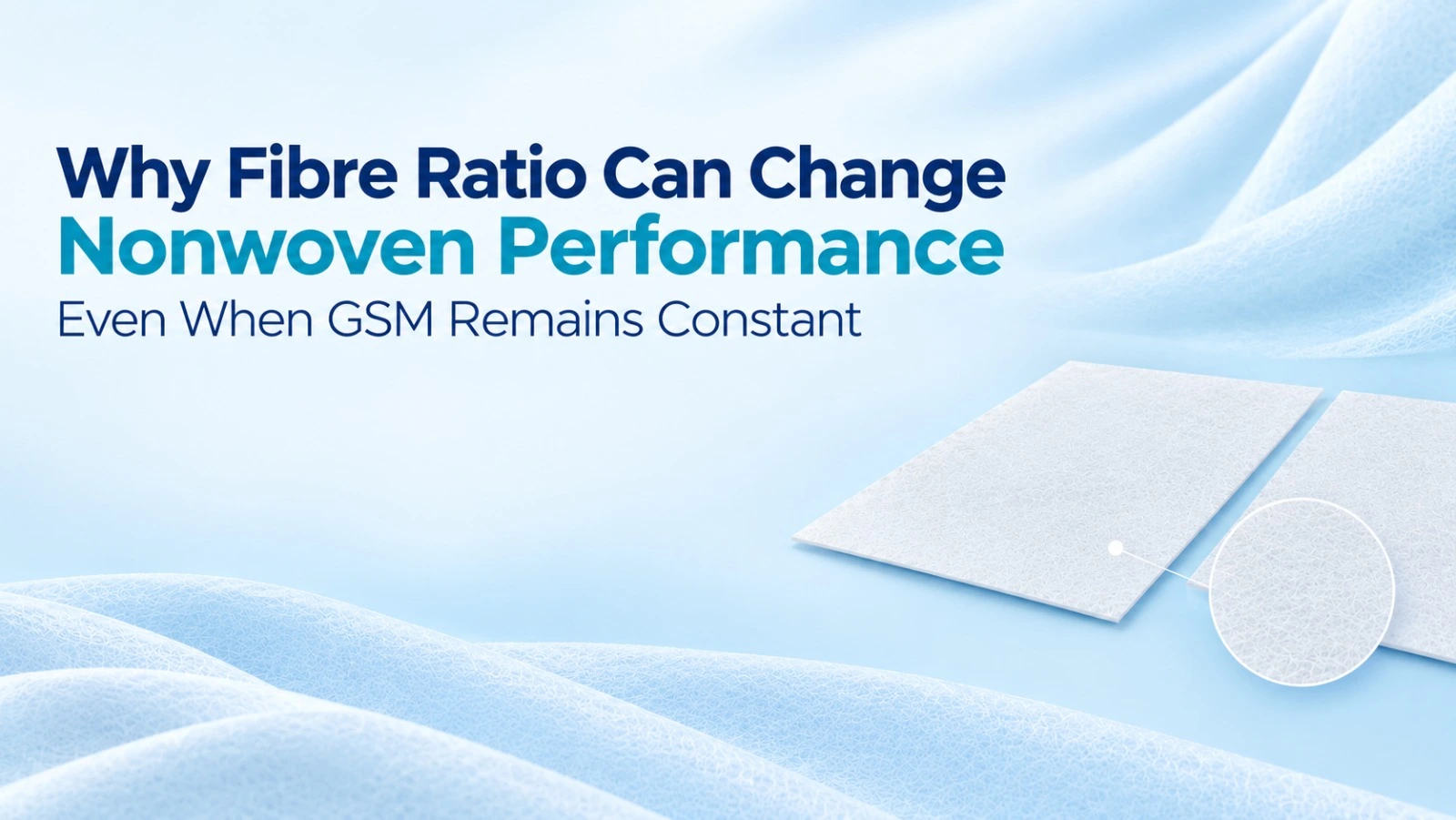
Why Fibre Ratio Can Change Nonwoven Performance Even When GSM Remains Constant
A buyer lines up two spunlace samples. Both are 50 GSM and the price per square metre is close.A buyer is comparing two spunlace samples. They are both 50 GSM and the cost per square meter is roughly equal. However, during the process of converting, one cloth gets torn as soon as it touches the water, while the other does not tear apart, but it appears to be light in weight and stiff.The spec sheets were identical, so what caused such a difference? This happens more often than people admit, and the reason is simple. GSM tells you how much fabric sits in a square metre. It says nothing about what that fabric is made of.
-
Recent Post
-
What Should Be Validated Before Moving From a Nonwoven Trial to Commercial Production?
A trial run that performs well doesn't automatically mean you're ready to commit commercial volume.
14.10.2026
Read Article -
Best GSM For Wet Wipes A Procurement Guide for Choosing the Right Spunlace Fabric
Getting the GSM wrong is one of the most common and most expensive mistakes in wet wipes sourcing.
20.06.2026
Read Article -
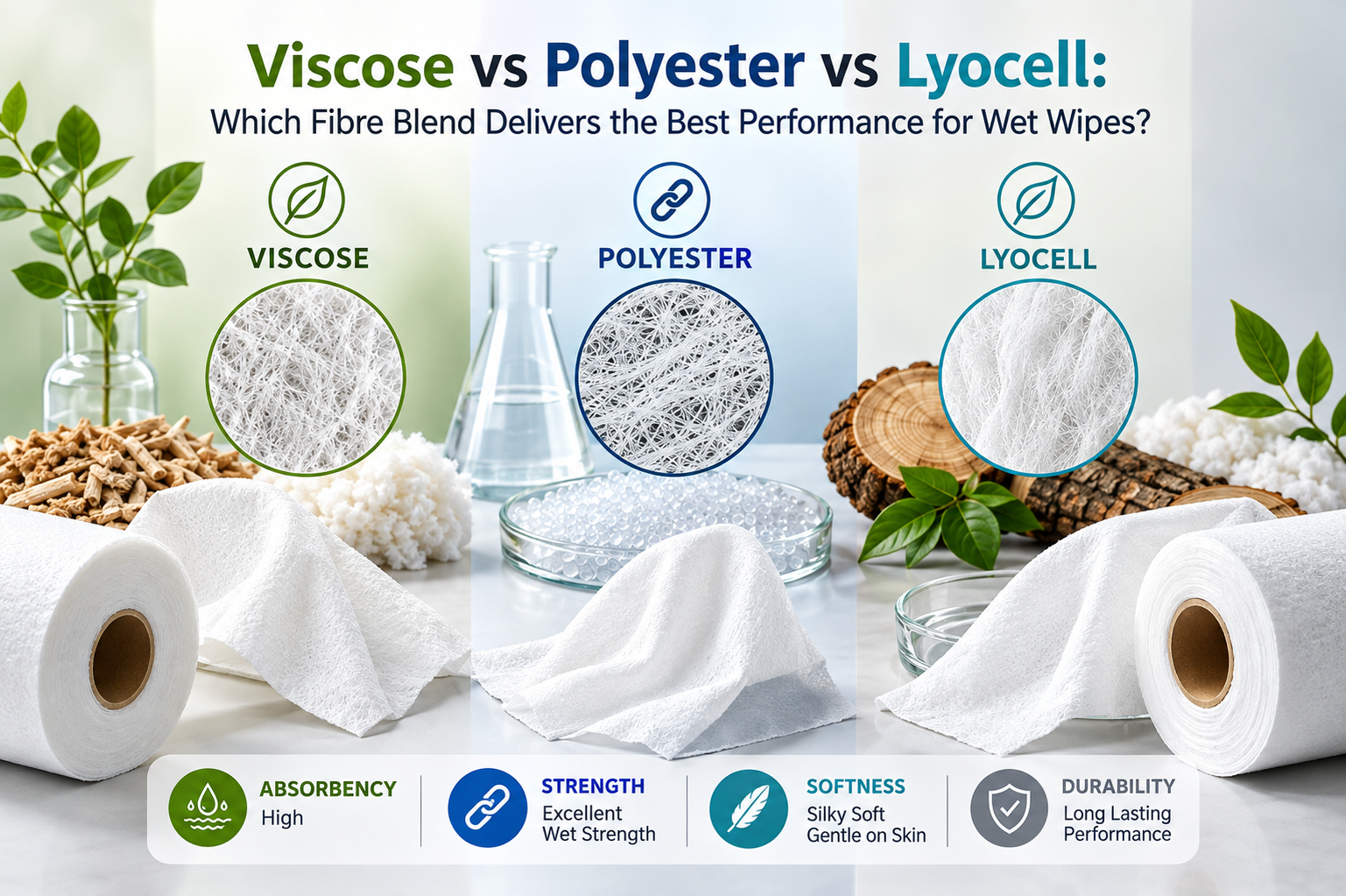
Viscose vs Polyester vs Lyocell: Which Fibre Blend Delivers the Best Performance for Wet Wipes?
Choosing between viscose, polyester, and Lyocell isn't really about picking a "best" fibre. It's abo
22.06.2026
Read Article -
How to Choose the Right Spunlace Nonwoven Fabric Manufacturer for Your Business
Sourcing decisions in the nonwoven category rarely fail because of price. They fail because a buyer
15.09.2026
Read Article -
How Global Wet Wipe Brands Evaluate Nonwoven Fabric Suppliers Before Signing a Contract
Multinational wet wipe brands don't sign with a nonwoven fabric supplier off a single sample and a g
08.09.2026
Read Article -
100 Percent Plastic Free Nonwovens: What Global Buyers Need to Know in 2026
Learn how plastic-free nonwoven materials are helping brands meet evolving EU and US sustainability
14.08.2026
Read Article - View All Blogs
-
Need nonwoven solutions for your application?
Talk to our team about custom fabrics, sustainability, and product development tailored to your industry.
Frequently Asked Questions
Know everything — be it our products, our process, or why nonwovens are so cool.
What is GSM in non-woven fabric?
GSM stands for grams per square meter, meaning weight of one square meter of fabric. It is a measure of weight, not strength, softness or absorbency of fabric, which depends on fiber used and its blend.
Does higher GSM mean better quality?
Not necessarily, because more GSM implies more material. Its quality is determined by suitability of the blend and bonding for intended use. One can build superior fabric with lower GSM.
Which is better, 180 GSM or 240 GSM?
Both GSMs are too high for wipes, for which the majority of spunlace fabrics is significantly lighter. They are suitable for uses where thickness is a must. First determine your application, and only after that – GSM and fiber blend.
Which GSM fabric is best?
There is no such thing as the best. The optimal GSM is the lowest weight that will provide the necessary strength, absorbency and hand of the product. You can learn about common GSM of wet wipes in our wet wipe GSM guide.
Is 200 GSM fabric heavy?
It is very heavy for wipes. For garments, it is an average GSM. Always judge GSM against the application, not in isolation.
Can two fabrics with the same GSM perform differently?
Yes. The same weight can come from different fibres, ratios, fibre fineness and bonding, and each changes strength, absorbency and softness. Ask for fibre composition and test results, not GSM alone.
Explore Recent Blogs
Why Fibre Ratio Can Change Nonwoven Performance Even When GSM Remains Constant
A buyer lines up two spunlace samples. Both are 50 GSM and the price per square metre is close.A buy
Read More
What Should Be Validated Before Moving From a Nonwoven Trial to Commercial Production?
A trial run that performs well doesn't automatically mean you're ready to commit commercial volume.
Read More
Best GSM For Wet Wipes A Procurement Guide for Choosing the Right Spunlace Fabric
Getting the GSM wrong is one of the most common and most expensive mistakes in wet wipes sourcing.
Read More
Viscose vs Polyester vs Lyocell: Which Fibre Blend Delivers the Best Performance for Wet Wipes?
Choosing between viscose, polyester, and Lyocell isn't really about picking a "best" fibre. It's abo
Read More

Weave Your Success with Our Revolutionary Fabrics
Power your business with Elixrr's cutting-edge nonwoven fabric solutions. Eco-friendly, customizable, and engineered for excellence—because innovation starts with the right foundation.

What GSM actually tells you
GSM stands for grams per square metre. It is a weight per unit area, which makes it useful for estimating yield, cost and rough thickness. If you buy the roll, you need it.
But it is a mass figure and nothing more. It does not describe which fibres make up that mass, how fine they are, or how they were bonded. Even the density of the raw material changes the picture. Polypropylene is lighter than polyester or viscose, so the same GSM holds a larger volume of polypropylene fibre. Two fabrics at identical weight can therefore be quite different structures.
How fibre ratio changes performance
Most spunlace wipes are blends, and the share of each fibre shapes how the fabric behaves.
Strength. Polyester is strong, springy and keeps its strength when wet. Viscose is softer but loses a good part of its strength once it absorbs liquid. Lyocell sits in between and holds up better wet than viscose. Raise the polyester share and the fabric usually gets tougher. Raise the viscose share and it gets weaker, particularly in a wet wipe.
Absorbency. Viscose, cotton and pulp take in liquid and hold on to it. Polyester does not. A blend with more cellulose-based fibre will hold more lotion, while a polyester-heavy blend holds less and tends to release it more freely when you wipe.
Softness and drape. Viscose and lyocell give a soft, fluid hand. The polyester feels firmer and more resilient, but the fineness of the fibre determines the softness: a fine polyester fibre can be softer than a coarse viscose fibre.
Pulp. Addition of pulp improves the absorbency and bulk of the paper at a lower cost than by using more fibrous raw materials. The trade-off is strength, and in some uses linting, so the share has to be chosen with the end use in mind.
Same GSM, different results: an example
Imagine two types of 50 GSM fabric. This is just an example and not actual test results.
Fabric A contains viscose fiber but has more polyester content. It is soft, picks up much lotion and hangs well. When it becomes wet, however, it is the weaker fabric of the two and can be torn when wiped.
Fabric B contains polyester fiber but has less viscose content. It remains strong when wet, rebounds well from folding, and is easy to remove lotion from. It retains less liquid and is not as plush.
Neither is the superior fabric. Fabric A is appropriate for a facial or baby wipe while Fabric B is good for a house-hold or industrial wipe which will be scrubbed. Same weight, different jobs.
Why this matters when you buy
If GSM is the only number on your purchase spec, you are leaving the performance to chance. A better spec asks for:
The most reliable step is practical. Request samples at the same GSM from different blends and test them on your own line, with your own lotion. A fabric can look right on paper and still fail on a converting line.
We cover how to pick a weight in our GSM guide for wet wipes, and how the three main fibres compare in our viscose, polyester and lyocell breakdown.
Choosing a ratio for your wipe
A few starting points, not rules:
The right answer depends on your product, your line speed and your market. You can browse the SoftSpun, AbsorvSpun and EnduraSpun ranges, or talk to our team about a sample at your target GSM.